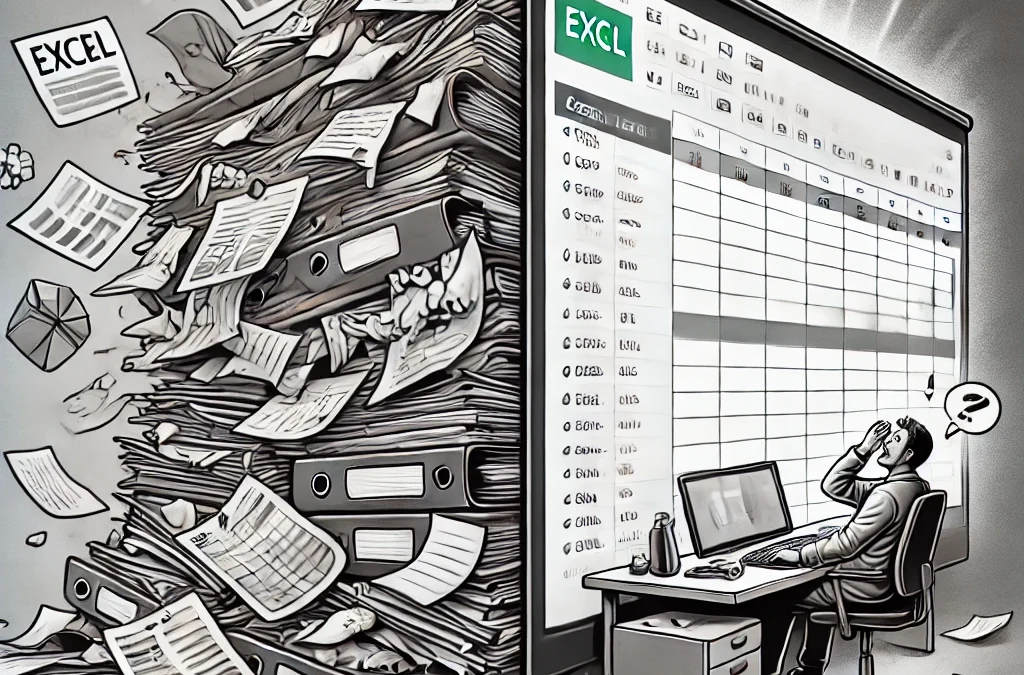
In the labyrinth of modern business operations, Excel sheets often find themselves at the heart of many companies’ workflows. They are ubiquitous, familiar, and deceptively simple. However, as organizations grow and processes become more intricate, this humble tool shows cracks in its armor. What was once a beacon of efficiency can quickly devolve into a quagmire of inefficiency, errors, and frustration—like using duct tape to fix a leaky pipe. Sure, it works… until it doesn’t.
The Allure of the Ubiquitous Spreadsheet
Excel has been the go-to tool for businesses of all sizes for decades. Its strengths are undeniable:
- Simplicity and Accessibility: It’s universally understood and requires minimal training. If you can click and type, congratulations, you’re an Excel expert (or so you think).
- Versatility: From budget tracking to project planning, it can do it all—or at least seem to. It’s like that one friend who says, “I’m good at everything” but secretly struggles to boil water.
- Affordability: When budgets are tight, Excel offers a low-cost solution. It’s the instant noodles of business tools: cheap, easy, and questionably reliable for long-term sustenance.
These qualities make it an attractive choice for startups, small businesses, and even larger corporations looking to solve immediate problems. But like a cheap umbrella in a thunderstorm, it’s only a matter of time before it flips inside out.
The Cracks Beneath the Surface
But what happens when your company scales, and those simple spreadsheets start to feel like sandcastles facing a rising tide? Spoiler alert: chaos.
1. Human Error: The Silent Saboteur
A misplaced decimal, a forgotten formula, or an overlooked update—Excel thrives on human input, and therein lies its greatest vulnerability. Studies reveal that nearly 88% of spreadsheets contain errors. In critical operations, these mistakes can translate into financial losses, tarnished client relationships, and operational delays. Think of it as playing Jenga: one wrong move, and the whole tower comes crashing down.
2. Collaboration Nightmares
Ever tried working on a shared Excel sheet with a team? It’s like herding cats—but the cats are blindfolded and arguing over which version is the “real” one.
- Version control becomes a logistical circus: Is “Budget_v3_FINAL_FINAL2.xlsx” really the final version, or is it just another decoy?
- Simultaneous edits often lead to overwritten data or lost progress. “Who deleted column E?!” is the rallying cry of Excel teams everywhere.
- Teams waste precious hours debating whose data is the “truth.” (Spoiler: it’s probably no one’s.)
Collaboration in Excel may work for small teams, but for growing organizations, it’s akin to fitting square pegs into round holes while blindfolded.
3. Scalability: A Wall You Will Hit
Excel’s structure is inherently static. It’s not built to handle exponential data growth or the complexities of multi-department workflows. As your client base or operations expand, the spreadsheet that once seemed limitless begins to buckle under the weight of your ambitions. It’s like trying to pack for a six-month trip with a carry-on bag—good luck.
4. Security Woes
Let’s talk about protecting sensitive data. Sharing Excel sheets via email or cloud services is the digital equivalent of leaving your house keys under the doormat. Unlike specialized systems, Excel lacks robust, built-in security protocols tailored for enterprise-grade data protection. Hackers probably refer to shared Excel files as “low-hanging fruit.”
5. Lack of Real-Time Insights
Business today demands agility. Decisions must be made swiftly, often based on real-time data. Spreadsheets, with their manual updating and static nature, are ill-suited to deliver actionable insights on demand. This delay can cost organizations opportunities in fast-moving markets. Imagine running a race with one shoe on—sure, you’re moving, but not fast enough to win.
When Excel Outgrows Its Usefulness
Excel is not inherently flawed—it’s simply a tool designed for a different era of business. For startups and freelancers, it offers an excellent entry point. However, for businesses aiming to scale, innovate, and lead in their industries, clinging to spreadsheets is like racing a bicycle on a Formula 1 track. The intentions may be noble, but the results are predictably disastrous.
Here’s how organizations are reevaluating their reliance on Excel:
- Automation Over Manual Entry: Manual processes are being replaced with workflows that reduce errors and save time. Robots don’t forget decimal points.
- Centralized Data Management: Companies are consolidating data into unified platforms to eliminate silos and foster collaboration. One truth, no debates.
- Enhanced Security: With increasing regulatory scrutiny (think GDPR, CCPA), businesses are shifting towards tools with in-built compliance features. Because no one wants to explain a data breach to Karen from HR.
- Scalability: Modern systems are designed to grow with your organization, seamlessly adapting to increased data and complexity. No more carry-on baggage for your six-month trip.
The Hidden Costs of Sticking to Spreadsheets
Sometimes, what seems cost-effective is anything but. The true price of Excel dependency isn’t measured in software licenses—it’s hidden in the hours spent fixing errors, recovering lost data, and manually collating reports. It’s reflected in the opportunities missed due to slow decision-making and in the frustration of employees trying to force a square peg into a round hole. Or worse, into a triangle.
The Way Forward
The future belongs to businesses that embrace adaptability and innovation. While Excel may always have a place in niche or supplementary tasks, its dominance as a core business tool is fading. Emerging technologies—automation platforms, CRMs, data analytics tools—offer not just alternatives but transformative solutions. They promise a world where errors are minimized, collaboration is seamless, and scalability is no longer a pipe dream.
It’s like moving from a horse-drawn carriage to a Tesla—sure, both will get you there, but one’s a little more suited to the fast lane.
Final Thoughts
Looking to explore smarter tools and strategies for your business? Visit Dgtia.com for insights, solutions, and more.
As your organization looks to the horizon, it’s worth asking: is your reliance on Excel a reflection of your potential—or a limitation on it? Evolving beyond spreadsheets isn’t just about embracing new technology; it’s about unlocking efficiency, agility, and resilience. It’s about stepping into a future where your tools work for you, not the other way around.
The question isn’t whether your business can afford to move beyond Excel—it’s whether it can afford not to. Or, to put it humorously: Do you want to upgrade your ride, or are you happy riding a unicycle on the highway?